DevSecOps Expertise
A production release should never be a gamble.
Shipping fast and shipping safely aren't opposing goals — it's the traditional approach that pits them against each other: manual deployments, end-of-project audits, vulnerabilities discovered in production. AKILI Labs automates and standardizes your CI/CD pipeline with security built into every step, from code to operations.
■ The situation
Security bolted on at the end is a debt, not a protection
In many organizations, shipping an application is still a high-risk exercise: manual deployments, environments that drift between development and production, fixes postponed because "it works." Every release becomes a dreaded event instead of a controlled non-event.
Vulnerabilities discovered in production cost the most.
DevSecOps catches them early — at design, in code, in tests — reducing remediation costs and strengthening the trust of clients and partners.
AKILI Labs automates and standardizes your delivery chain end to end: continuous integration and deployment, containerization, infrastructure described as code, automated security analysis, and monitoring — for frequent, reproducible, auditable releases.
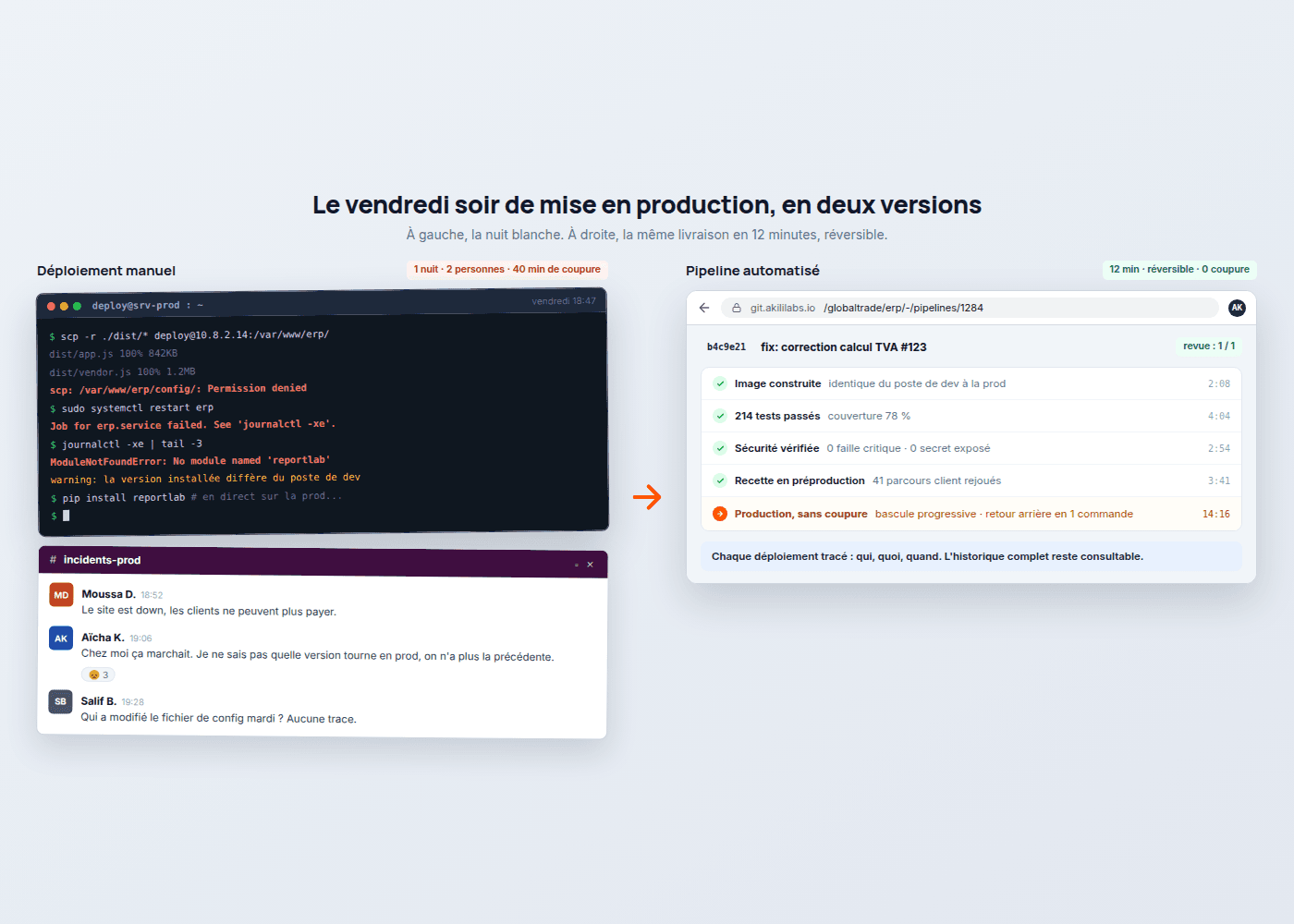
■ Scoping & Industrialization
In 5 phases, move from manual deployment to secure continuous delivery
Each phase produces a tangible deliverable that you validate before moving to the next.
1
Maturity Audit
Assessment of your infrastructure, delivery processes, and security practices.
▸ Deliverable: DevSecOps diagnostic and prioritized industrialization plan
Maturity Audit
Assessment of your infrastructure, delivery processes, and security practices.
▸ Deliverable: DevSecOps diagnostic and prioritized industrialization plan
1
2
Continuous Delivery Foundations
Automation of testing and deployments on a pilot scope.
▸ Deliverable: Operational pipelines — errors detected in minutes
2
Continuous Delivery Foundations
Automation of testing and deployments on a pilot scope.
▸ Deliverable: Operational pipelines — errors detected in minutes
3
Containerization & Infrastructure as Code
Packaged environments and versioned infrastructure, rebuildable identically.
▸ Deliverable: Reproducible, aligned DEV/QA/PROD environments
Containerization & Infrastructure as Code
Packaged environments and versioned infrastructure, rebuildable identically.
▸ Deliverable: Reproducible, aligned DEV/QA/PROD environments
3
4
Integrated Security
Automated vulnerability and code quality analysis, secrets management, hardening.
▸ Deliverable: Security controls run on every release
4
Integrated Security
Automated vulnerability and code quality analysis, secrets management, hardening.
▸ Deliverable: Security controls run on every release
5
Monitoring & Operational Maintenance
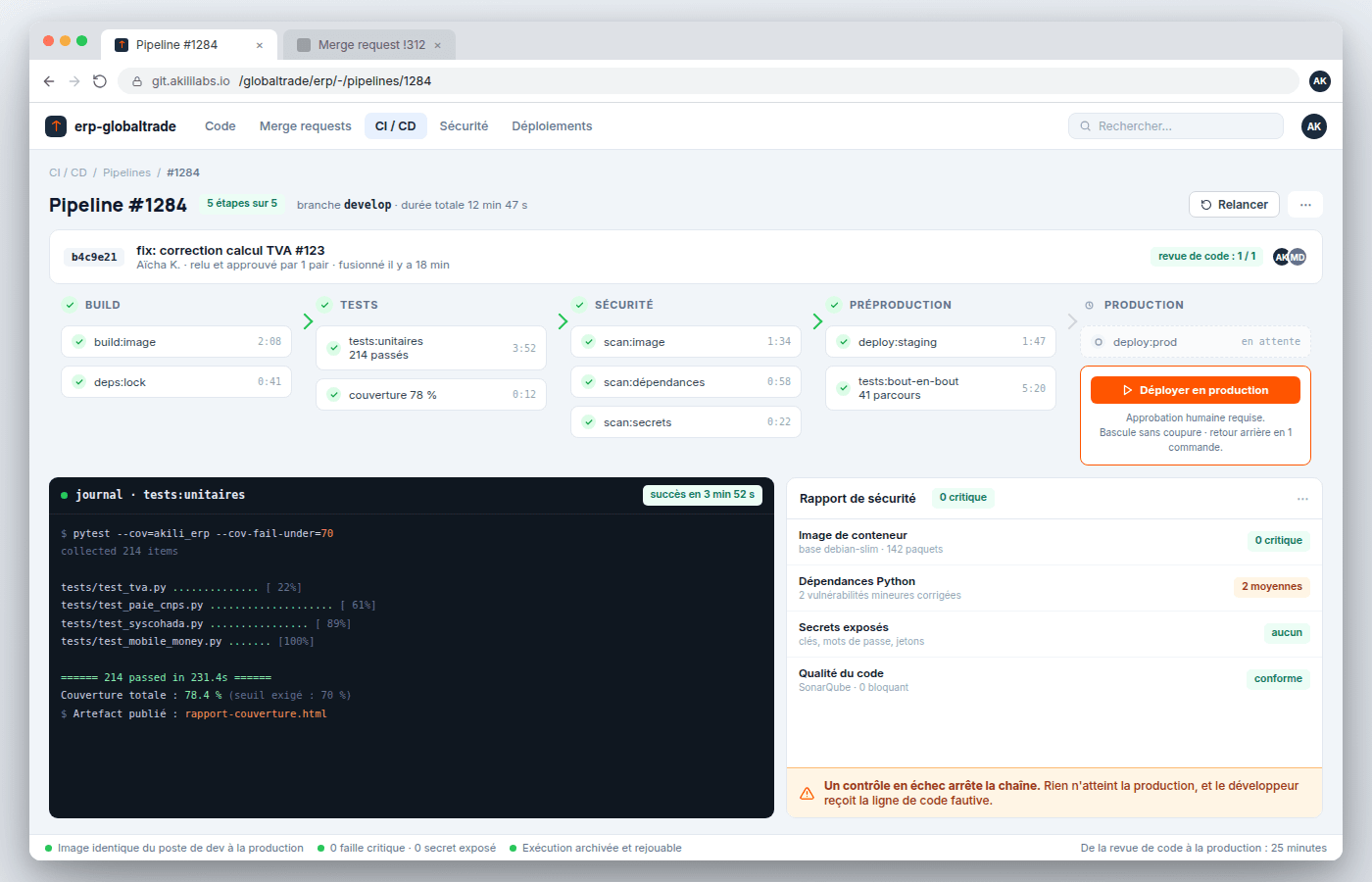
Metrics, alerts, centralized logging, knowledge transfer.
▸ Deliverable: Operations dashboard, autonomous teams
Monitoring & Operational Maintenance
Metrics, alerts, centralized logging, knowledge transfer.
▸ Deliverable: Operations dashboard, autonomous teams
5
■ Areas of Intervention
Five levers for frequent, reproducible, auditable releases
Continuous Integration & Delivery
Catch errors in minutes, not in production: automated tests on every change, releases in hours rather than weeks.
Tools: GitLab CI/CD, GitHub Actions
Containerization & Orchestration
Identical environments from development to production: reproducible deployments, isolated services, controlled scaling.
Tools: Docker, Kubernetes
Infrastructure as Code
Your infrastructure described in versioned files: reproducible, auditable, deployable in minutes.
Tools: Terraform, Ansible
Automated Security Analysis
Vulnerabilities and technical debt caught on every release — before they reach your users.
Tools: OWASP, SonarQube
Monitoring & Observability
Know what's happening before your users do: metrics, alerts, and centralized logs.
■ Technical Stack
The tools we master — and your teams will too
CI/CD
GitLab CI/CD
GitHub Actions
Containers & Orchestration
Docker
Kubernetes
Infrastructure as Code
Terraform
Ansible
Security & Quality
OWASP
SonarQube
Cloud
AWS
Google Cloud
Azure
OVH
On-premise Linux
■ Beyond the pipelines
Tooling isn't enough: your teams need to stay in control
Training & Knowledge Transfer
Your teams operate the pipelines and infrastructure independently; the provider should never become a dependency.
Cloud Migration
A carefully planned path to the cloud or a hybrid setup, based on your cost, connectivity, and sovereignty constraints.
Staff Augmentation & TMA (Application Maintenance)
Expert reinforcement within your teams, or platform maintenance under contractual commitments: critical incidents (P1) resolved on time 100% of the time, major incidents (P2) 95% or more.
Integration with Existing Systems
Your pipelines integrate with your existing tools — code repositories, Odoo ERP, business applications — with no big-bang rollout.
■ Security & Traceability
Compliance is proven with logs, not with promises
Containerizing applications, automating deployments, migrating to the cloud: every step of industrialization shifts security responsibilities. Who accesses production environments? Where do secrets live — passwords, keys, certificates? What happens when a critical fix needs to go out on a Friday night?
A serious DevSecOps chain makes these questions traceable: every deployment is logged, every access is controlled, every environment can be rebuilt identically. For regulated organizations in the zone — banks, microfinance, insurance — this traceability isn't a nicety: regional regulators require demonstrable management of IT risk and business continuity.
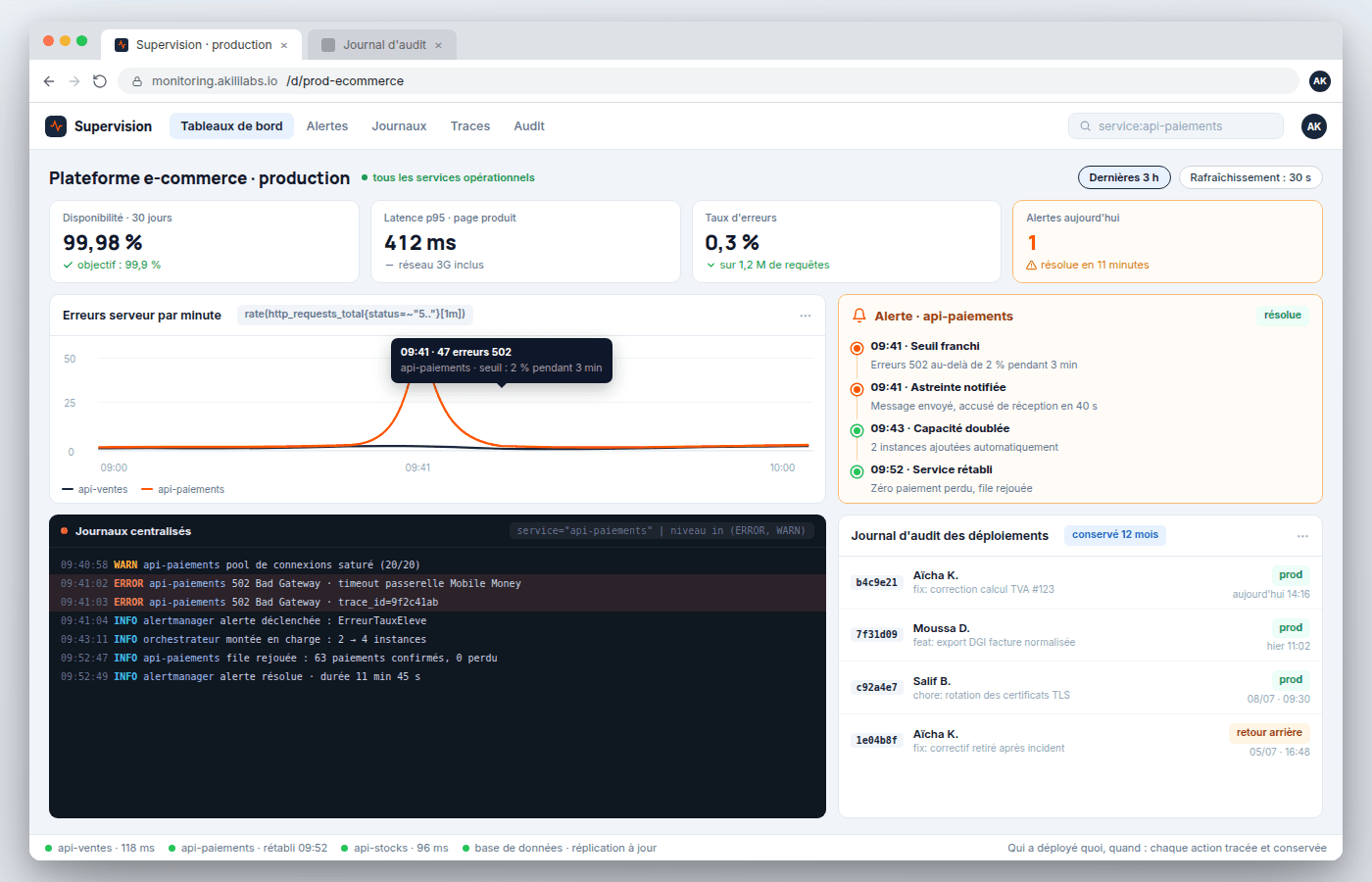
Segregated Environments
Separate DEV, QA/staging, and PROD environments, restricted production access, mandatory code reviews before merging — the standards we apply to our own projects.
Secrets & Access
Centralized secrets management, least-privilege principle, logging of access to sensitive environments.
Sovereignty & Hosting
Public cloud, private cloud, or on-premise: a deliberate choice based on data sensitivity and your oversight bodies' requirements.
■ Our methodology
An approach centered on reliability, not on trendy tools
Start Small, Prove Fast
A pilot scope that delivers continuously beats a two-year overhaul: value is demonstrated in weeks.
Security by Design
Controls live in the CI/CD pipeline, not in an annual audit: every change is tested, analyzed, and tracked.
UEMOA Realism
Variable connectivity, cloud costs in foreign currency, small teams: our architectures work in your context, not just in demos.
Knowledge Transfer
Your teams operate the platform independently once our engagement ends.
■ Sectors we serve
Every sector has its own availability constraints — we start from yours
Finance & Institutions
Audited pipelines, strict environment separation, deployment traceability required by regulators
Trade & Distribution
High availability for sales platforms, seasonal scaling, zero-downtime deployments
Telecoms & Utilities
Observability for critical services, proactive alerting, automation of recurring operations
Public Sector
Sovereign hosting, reproducible environments, knowledge transfer to internal teams
Industry
Continuous integration of business applications, monitoring of production systems
Healthcare
Segregation of sensitive data, access control, evidentiary-grade logging
■ What sets us apart
Why choose AKILI Labs
On-the-Ground African Expertise
Variable connectivity, cloud costs in foreign currency, small IT teams: our platforms are designed for this context, not despite it.
End-to-End Vision
From the maturity audit to day-to-day operations, a single point of accountability across the whole chain.
Experienced Team
11+ years of experience in information systems across Africa, Europe, and the Middle East.
We Practice What We Sell
Git, code reviews, separate environments, automated pipelines: the standards we deploy for our clients are the ones we apply to our own projects.
Local Presence, Regional Vision
Based in Abidjan, active across the entire UEMOA/ECOWAS zone.
The DevSecOps practice by the numbers
100%
of critical incidents (P1) resolved on time — SLA commitment
95%
of major incidents (P2) resolved on time, at minimum — SLA commitment
11+
years of experience
6
countries served (UEMOA/ECOWAS)
100%
of projects include knowledge transfer
■ Resources & Content
Deepen your DevSecOps practice
Coming soonGuide
CI/CD: where to start when you're still deploying by hand?
A realistic path to continuous delivery.
Coming soonChecklist
Questions to ask before migrating to Kubernetes
Assess whether orchestration is the right choice.
Coming soonGuide
Securing your CI/CD pipeline: the essential controls
The controls that matter, without over-engineering.
Coming soonWebinar
Infrastructure as Code in practice
A real-world demonstration.
■ FAQ
Frequently asked questions about DevSecOps
Your next production release deserves to be a non-event.
Let's start with a maturity audit: our experts analyze your delivery chain and propose an industrialization plan tailored to your context and constraints.