Business Intelligence Expertise
Your data already exists. What's missing is the decision.
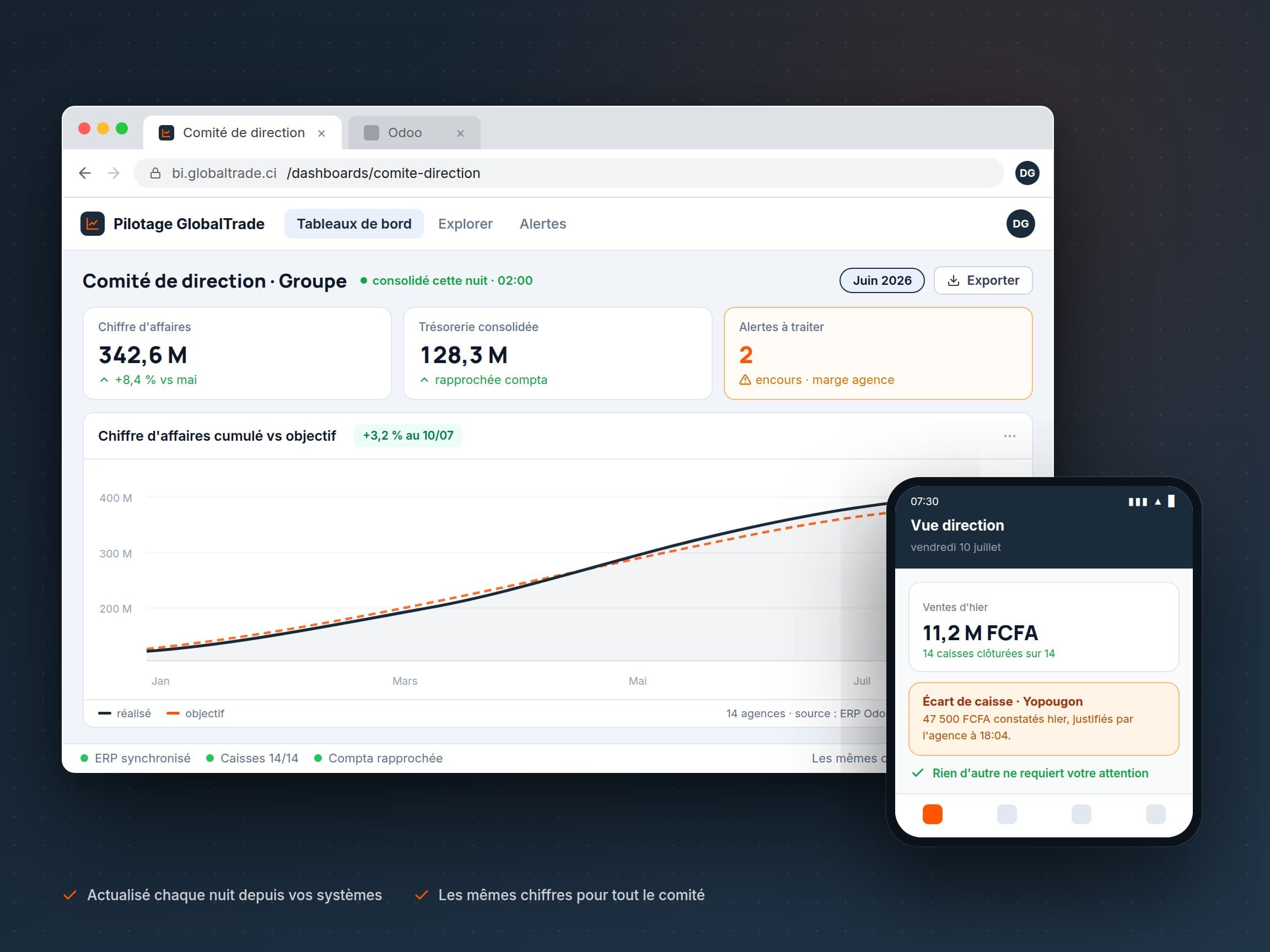
Sales, cash registers, inventory, Mobile Money: every day of activity produces numbers no one has time to consolidate. AKILI Labs turns this scattered data into reliable dashboards, refreshed every morning, so you decide on what's real — not on last month's report.
11+
years of data experience
6
UEMOA/ECOWAS countries
100%
of projects delivered with skills transfer
■ The problem
The monthly report costs two days. And it's already outdated.
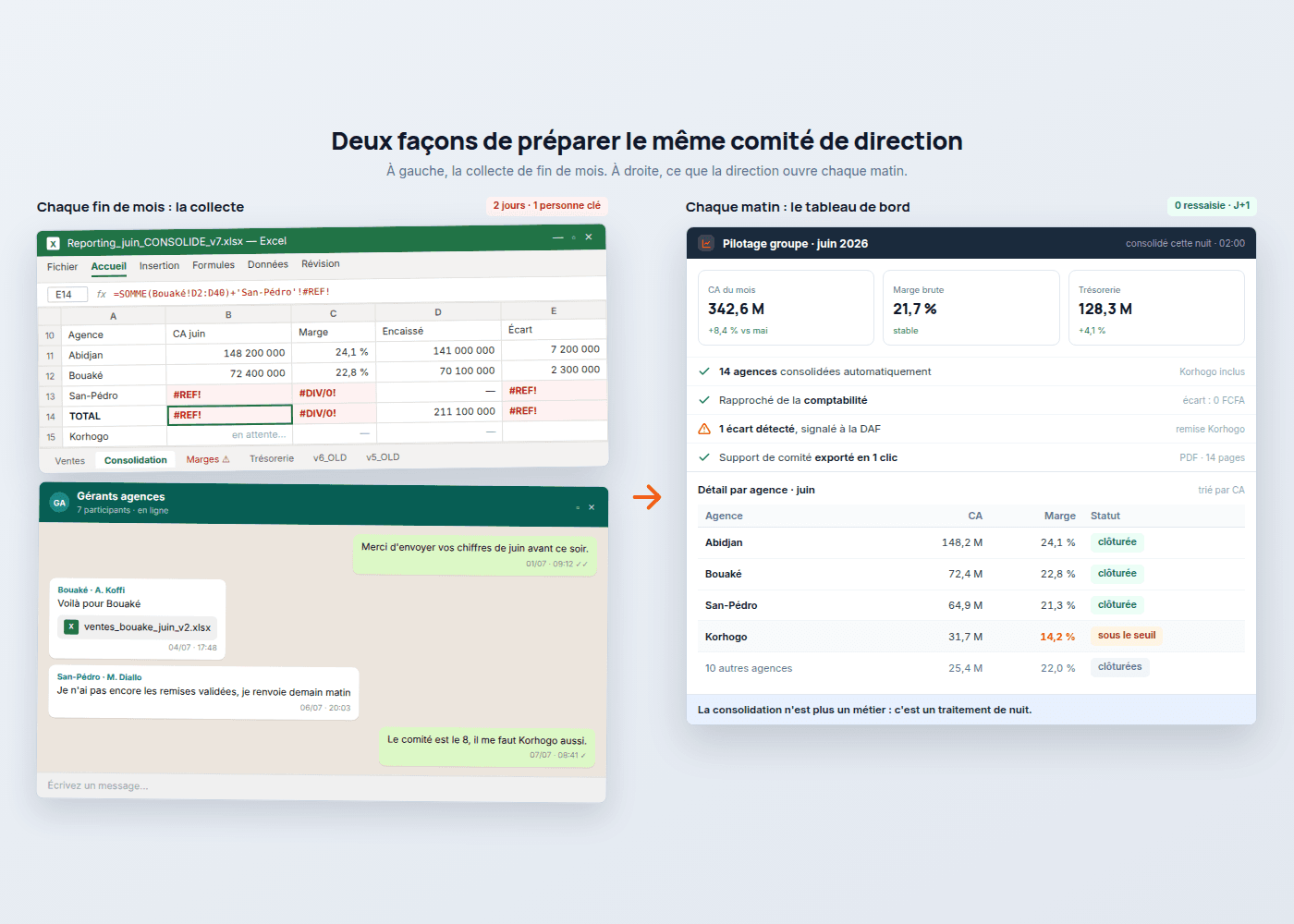
In most companies in the region, decision-making relies on an exhausting ritual: at the end of every month, one trusted person collects files from the branches, copies out the ERP figures, reconciles discrepancies by hand, and formats a committee report. Two days of work, numbers that diverge depending on the source, and management discovering on the 5th of the month what happened three weeks earlier.
Our approach: yesterday's numbers, available every morning. Consolidation becomes an overnight process, no longer a job.
The problem is almost never a lack of data. It's that it's asleep across five systems that don't talk to each other, and that the one person who knows how to piece it together will one day go on leave.
■ Day-to-day with BI
A typical morning, at 7:30 AM, on your phone
No three-week training and no decision-support jargon: screens that answer the questions you're already asking. How much did we sell yesterday? Where's our cash position? Which branch is falling behind? Who needs a follow-up call?
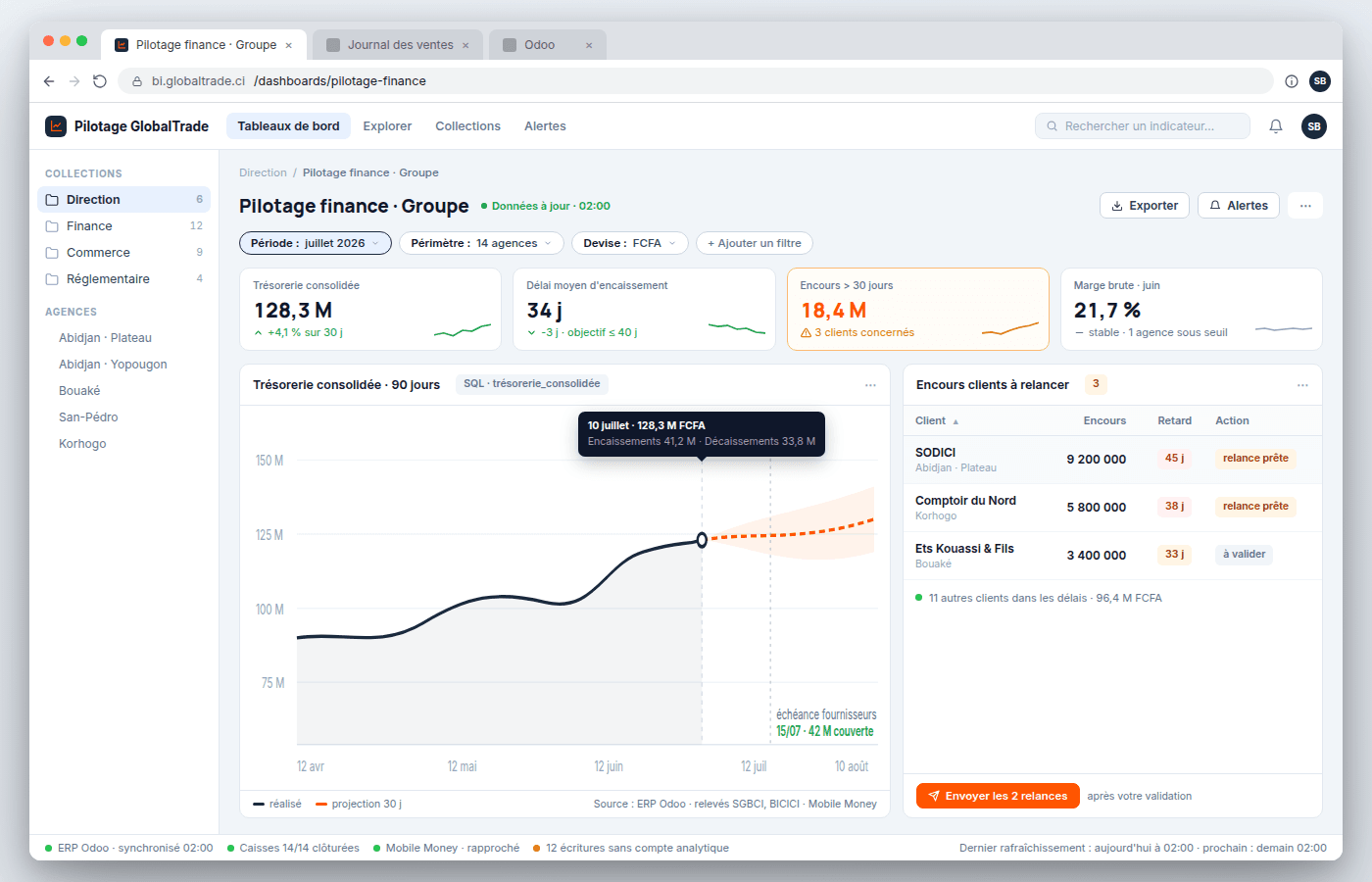
From hindsight to foresight
A dashboard tells you where you stand. The next step is to anticipate: demand forecasting, anomaly detection, scoring. That's the territory of our Artificial Intelligence practice, which builds precisely on the data warehouse constructed here.
■ What we do
From assessment to daily decision-making
Data Scoping & Master Plan
Inventory of your sources (ERP, Excel, cash registers, Mobile Money), definition of the KPIs that matter to your committee, and a roadmap prioritized by value.
Deliverable: KPI dictionary + roadmap
Data Warehouse & Data Flows
Automatic, historized consolidation of your systems into a single data warehouse, with quality rules at intake. Your data belongs to you, hosted wherever you decide.
Deliverable: Documented data warehouse + supervised nightly flows
Dashboards & Reporting
Management, finance, sales, and operations dashboards; regulatory statements and committee exports generated from the same data.
Deliverable: Dashboards in production + automated exports
Adoption & Autonomy
Training your teams in data exploration, skills transfer, TMA (application maintenance) support. Our stated goal: you no longer need us to build a new KPI.
Deliverable: Autonomous team + documentation
■ Under the hood
One single path for data, from the till to the boardroom
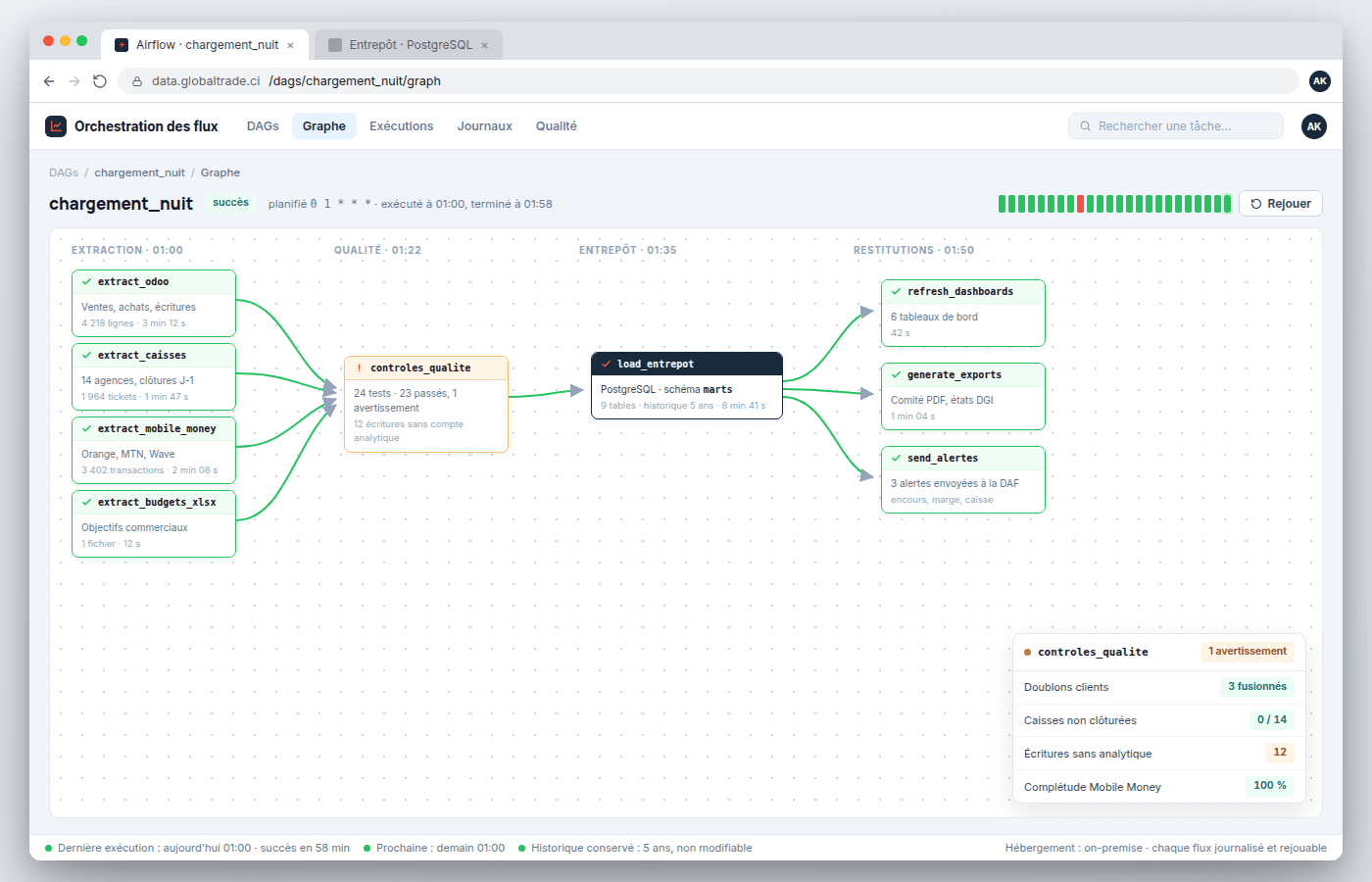
Every figure displayed can be traced back to its source. The data flows run overnight, monitor themselves, and a failed load is visible before anyone presents a wrong number.
■ Data Governance
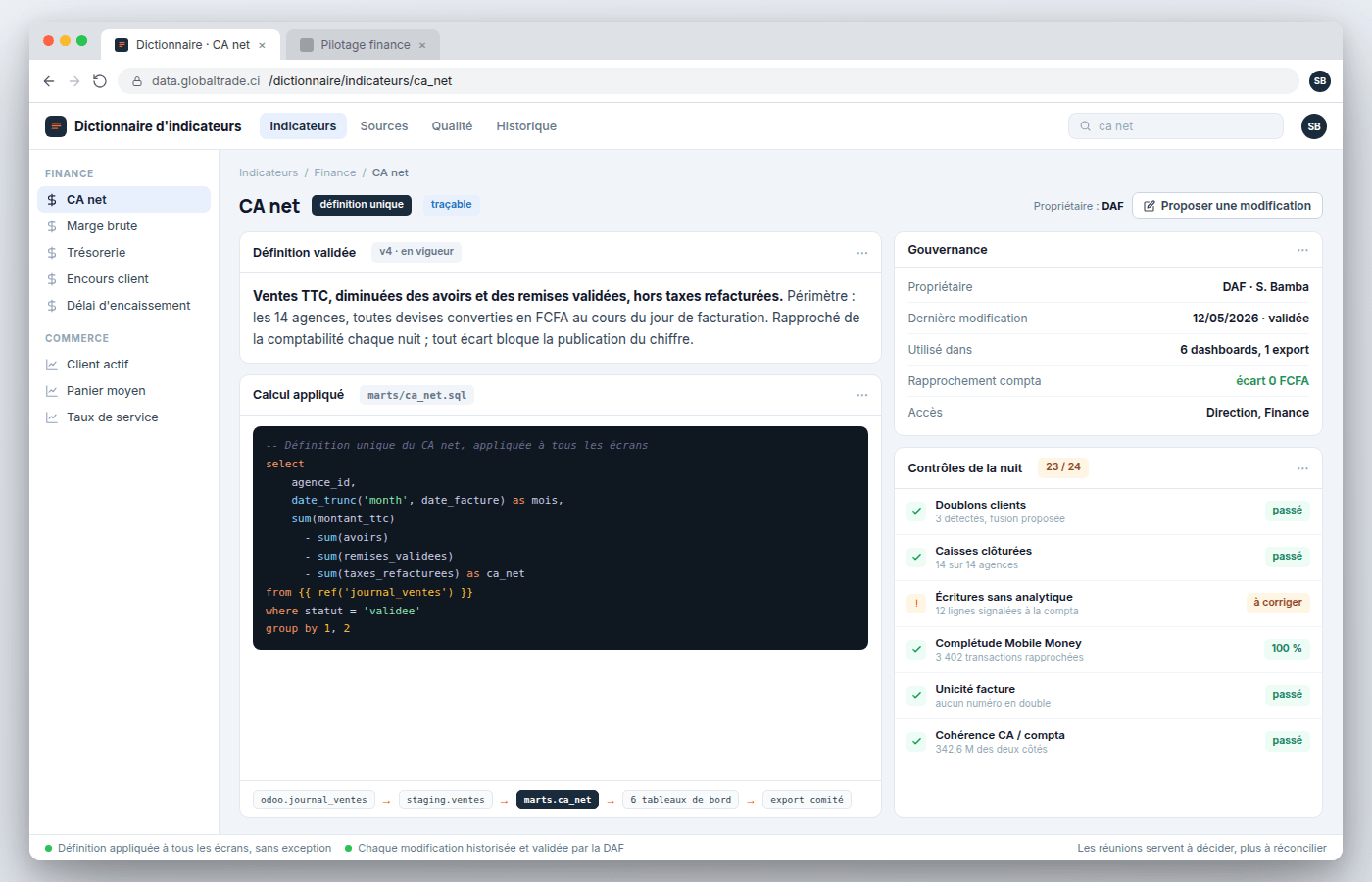
Why your revenue figure differs depending on who calculates it, and how we end that
“Net revenue,” “active customer,” “outstanding balance”: as long as every department has its own formula, meetings serve to reconcile numbers instead of making decisions. We write each definition once, with you, and the system then applies it everywhere: dashboards, exports, alerts.
Quality checks run every night with the data flows: duplicates, unclosed cash registers, incomplete entries become visible and fixable, instead of being discovered at year-end close.
■ Compliance
The statements that aren't up for debate: on time, accurate, archived
For banks, MFIs, and regulated institutions, BI isn't just about decision-making: it's the ability to produce the periodic statements required by the regulator without tying up a team for a week.
Periodic Regulatory Statements
For banks and MFIs: the statements required by the BCEAO and the Banking Commission, generated from the data warehouse with an audit trail, in line with your license and obligations.
OHADA Reporting Package & Annexes
The same data as accounting, never a parallel re-entry: what the statutory auditor sees is what the committee sees.
Donor & Parent Company Reporting
Mandated formats (Excel, XML) produced automatically at each deadline, without tying up a team for a week.
Figure-by-figure traceability, right down to the original entry, is at the heart of our architecture, not an option. It's what makes a regulatory statement defensible before both the regulator and the statutory auditor.
■ Our approach
A first dashboard in production within 6 weeks
With a defined scope and accessible sources: that's the first thing we verify together during scoping.
1
Scoping
2 weeks
KPI workshops with management, source inventory, v1 dictionary.
Deliverable: Prioritized roadmap
Scoping
2 weeks
KPI workshops with management, source inventory, v1 dictionary.
Deliverable: Prioritized roadmap
1
2
Foundation & First Data Flow
2 weeks
Data warehouse set up, first source connected (usually the ERP), quality measured.
Deliverable: Reliable nightly data
2
Foundation & First Data Flow
2 weeks
Data warehouse set up, first source connected (usually the ERP), quality measured.
Deliverable: Reliable nightly data
3
First Dashboards
2 weeks
The two screens that make the next committee meeting a win; acceptance testing with real users.
Deliverable: Go-live
First Dashboards
2 weeks
The two screens that make the next committee meeting a win; acceptance testing with real users.
Deliverable: Go-live
3
4
Expansion & Autonomy
2-week sprints
New sources, new screens, training; the scope adjusts at every demo.
Deliverable: Autonomous team
4
Expansion & Autonomy
2-week sprints
New sources, new screens, training; the scope adjusts at every demo.
Deliverable: Autonomous team
■ Sectors
What BI changes, sector by sector
Banking & Microfinance
Daily portfolio-at-risk tracking, regulator statements
Provisions anticipated, reporting delivered on time
Retail & Trading
Margin by branch and by product, discount tracking
Discounts under control, stock-outs anticipated
Industry & Agribusiness
Yield by line and by site, raw material costs
Variances seen weekly, not at year-end
Services & Construction
Profitability by contract and by site
Overruns detected before project close
Public Sector & Donors
Program KPI tracking
Automated donor reporting
Telecoms & Mobile Money
Reconciliation of transaction volumes
Discrepancies detected the next day
■ Why AKILI Labs
An integrator who knows your starting point
We Know Your Starting Systems
Odoo integrator and business software developer: we know how to connect a data warehouse to your real-world systems (ERP, Excel, cash registers), not to an idealized IT setup.
Regional Regulation, Built In
SYSCOHADA, BCEAO requirements, donor formats: the UEMOA context isn't an add-on for us, it's our home ground.
Open Source First
No per-user licensing that spirals out of control when the whole company wants to see the numbers. Your data and your tools belong to you.
Autonomy as a Deliverable
Systematic skills transfer: your team builds its own KPIs by the end of the project.
■ Technology Stack
Proven tools, chosen to last
Open source as the default choice, Power BI when your environment is already Microsoft: the tool adapts to your teams, not the other way around.
Warehouse & Databases
PostgreSQL
Data Warehouse
Data Lake
Data Flows & Transformation
Airflow
dbt
Airbyte
Odoo connectors
Mobile Money connectors
Reporting
Metabase
Apache Superset
Power BI
Grafana
Quality & Monitoring
dbt tests
Email & mobile alerting
Data flow logging
Hosting
On-premise
UEMOA cloud
European cloud
■ FAQ
Frequently asked questions about Business Intelligence
Let's talk about your first two KPIs
45 minutes with a consultant. What you get out of it, with no commitment:
- An honest assessment of your data assets
- The two KPIs to start with
- A read on your sources: ERP, Excel, cash registers, Mobile Money
- An indicative estimate of approach and budget